Category Archives: Uncategorized

WB4RL Repeater Monthly News – August 2026

Power Restored, Huntsville Hamfest Ahead, and Amateur Radio News

It has been a busy month around the WB4RL Repeater, and we have some good news to report!

WB4RL Repeater Power Issues Resolved

Many listeners and users of the WB4RL repeater have noticed intermittent outages over the past several weeks. The outages were related to electrical service problems in the area following the recent storms and the power-line work being performed near the repeater location.

We are happy to report that the power company has now completed the necessary line work in the area, and the electrical service problems affecting the repeater have been corrected.

With the utility work completed, the WB4RL repeater should once again be operating normally and providing the reliable coverage that our local amateur radio community has come to depend upon.

We appreciate everyone’s patience while the utility crews worked to repair and improve the electrical system in the area. We also appreciate the reports from local operators who let us know when they experienced problems.

As always, if you notice an unusual problem with the repeater, please let us know so we can investigate it.

Huntsville Hamfest and the 2026 ARRL National Convention

The big amateur radio event in North Alabama is almost here!

The Huntsville Hamfest will be held August 22–23, 2026, at the Von Braun Center South Hall in Huntsville, and this year’s event is especially significant because Huntsville Hamfest is hosting the 2026 ARRL National Convention.

The Hamfest will be open:

  • Saturday, August 22: 9:00 AM – 4:30 PM
  • Sunday, August 23: 9:00 AM – 3:00 PM

The event will once again feature commercial vendors, a large indoor flea market, clubs and organizations, forums, license testing, youth activities, prizes, and plenty of opportunities to meet fellow amateur radio operators. The Hamfest organizers report that dealer and club-table registrations are already full for 2026.

Admission is currently listed at $12 in advance or $15 at the door, with free admission for Scouts and Royal Rangers in uniform and children 12 and under.

For those traveling to Huntsville, the official Hamfest talk-in station will be operating on 146.94 MHz with a 100 Hz tone, with 145.33 MHz, also with a 100 Hz tone, listed as the backup.

More information is available at the official Huntsville Hamfest website.

ARRL National Convention – Friday, August 21

This year the ARRL National Convention adds an extra day of activities before the main Hamfest.

Friday, August 21, will feature ARRL training programs at the Embassy Suites by Hilton Huntsville, including Mini Contest University, the Emergency Communications Academy, and Salty Walt’s Portable Antenna Workshop. The training tracks run from approximately 8:00 AM to 4:30 PM and include the convention luncheon.

Friday evening brings a particularly unique event — the ARRL National Convention Dinner at the U.S. Space & Rocket Center, held underneath a full-size Saturn V rocket. The dinner includes museum access and special speakers, with proceeds benefiting the ARRL Education & Technology Program.

Registration for the Friday ARRL National Convention activities is separate from regular Huntsville Hamfest admission.

The ARRL Expo and Huntsville Convention information has the latest schedules and registration information.

Forums, Testing and Activities

The Huntsville Hamfest has expanded its forum schedule this year, with an additional room at the Embassy Suites. The organizers have now posted the 2026 forum agenda and Saturday and Sunday schedules.

License examinations are scheduled for Sunday at 10:00 AM, and the Youth Lounge will be open Sunday as well. Door prizes will be awarded throughout the weekend, with the main Sunday prize drawing scheduled for 2:00 PM.

If you are planning to attend, it is worth checking the Hamfest website before heading to Huntsville since schedules and individual activities can change.

Around the Amateur Radio World

There is plenty happening outside North Alabama as well.

ARRL has recently highlighted the continuing importance of Amateur Radio Emergency Service operations following severe weather and other disasters. Amateur radio operators in Wisconsin recently assisted with communications following tornado damage, while amateur operators in Colombia have been providing communications support following the major earthquake and aftershocks there.

These events are an important reminder of why maintaining reliable repeaters, radios, antennas, emergency power, and trained operators is so important. When commercial communications are disrupted, Amateur Radio operators can still provide a valuable communications link.

ARRL has also released its 2025 Annual Report, highlighting activities involving education, advocacy, emergency communications, technology, publications, and member services. The report also emphasizes the work of ARES volunteers and the role Amateur Radio continues to play in serving communities during emergencies and public-service events.

A Busy Weekend for North Alabama Hams

For operators in our area, next weekend is a great opportunity to get involved. Whether you are an experienced DX operator, a repeater regular, a new licensee, or someone thinking about getting into Amateur Radio, there will be something to see and do in Huntsville.

And don’t forget to keep an ear on the local repeaters while traveling to and from the Hamfest. Repeater talk-ins and local operators are often the easiest way to get directions, find other hams, or learn about activities happening around town.

We hope to see many of you in Huntsville for the 2026 Huntsville Hamfest and ARRL National Convention.

Until then, enjoy the WB4RL repeater, stay safe, and keep those radios on the air!

73,
The WB4RL Repeater Team
📰 WSHE379 GMRS Repeater News Update July 2026

🎉 WSHE379 is Now OPEN ACCESS!

We have some exciting news for the North Alabama GMRS community!

The WSHE379 GMRS Repeater is now Open Access! That means licensed GMRS operators are welcome to use the repeater to stay connected with family, friends, neighbors, and the community.

Whether you’re coordinating Back-to-School activities, traveling across North Alabama, checking in during severe weather, or simply enjoying the hobby, WSHE379 is here to help keep everyone connected.

Our goal has always been to provide a friendly, reliable communications resource that encourages more people to discover the value of GMRS. Open access means new operators have an opportunity to learn proper operating practices while experienced users can enjoy another dependable local repeater.

As always:

  • Use your FCC-issued GMRS call sign.
  • Be courteous and leave pauses between transmissions.
  • Welcome new operators to the system.
  • Help keep the repeater enjoyable for everyone.

We look forward to hearing familiar voices—and plenty of new ones—on the air!


🌎 Around the GMRS Community

GMRS continues to grow across the country as more families, off-road groups, preparedness teams, and community organizations discover the advantages of reliable local communications.

A recent example comes from Pennsylvania, where the Uniontown Amateur Radio Club installed a new open-access GMRS repeater specifically to improve community communications. Club members reported immediate participation from neighboring counties and even used the system to relay weather information during winter storms, demonstrating how local repeaters can strengthen everyday and emergency communications alike.

Another topic generating discussion throughout the GMRS community is a proposal that could eventually expand GMRS into additional low-band VHF frequencies. While enthusiasts are actively debating the idea, no FCC rule changes have been adopted, and GMRS operations continue under the current Part 95 rules.

The FCC continues to remind operators that GMRS repeaters may be remotely controlled over networks, but repeaters may not be linked together over the internet to carry GMRS communications.


📡 Join the Conversation

If you haven’t been on the air lately, now is the perfect time!

Whether you’re commuting, heading to school events, traveling this season, or just testing a new radio, give WSHE379 a call. We’d love to hear you on the repeater.

Stay safe. Stay connected. We’ll hear you on the air!

WB4RL Repeater Back Online

The repeater was disconnected Friday April 24, 2026 due to a water leak at the repeater location. We were notified of the power drop and leak and quickly arrived and disconnected mains from the power to the repeater location.

The leak was repaired yesterday and after a 24 hour dry out the repeater was returned this morning to operation.

WB4RL Repeater Upgrade: New 7 Element Yagi Antenna Now Online

We’re excited to share a major upgrade to the WB4RL repeater system! Our new 7 element, 11 dB gain Yagi antenna has officially been installed, mounted, tuned, and brought online—just in time for tonight’s East Coast Reflector “Open Mic Night” net.

This enhancement represents a significant step forward for our community. With the addition of the high-gain Yagi antenna, we are already seeing improved transmit distance, stronger signal clarity, and more reliable access across a wider coverage area. Operators who were previously on the fringe of the repeater’s range should now experience noticeably better performance.


What This Means for Our Community

The directional properties of the Yagi antenna allow us to focus RF energy more efficiently in the desired coverage direction. This translates into:

  • Extended reach by several miles
  • Improved signal strength and audio quality
  • Better reliability in weak-signal areas
  • Enhanced access for more operators across the region

This upgrade helps ensure that our repeater continues to serve as a dependable communications hub for both everyday operation and emergency use.


Behind the Installation: What’s Involved in Setting Up a Yagi Antenna

Installing and bringing a Yagi antenna online involves several important steps, each critical to achieving optimal performance:

1. Planning and Site Selection

Before installation, we evaluated the mounting location to ensure:

  • Proper height above ground for optimal propagation
  • Clear line-of-sight in the intended direction
  • Structural stability for mounting hardware

Directional antennas like Yagis require careful orientation, so determining the primary coverage direction is essential.

2. Assembly of the Yagi

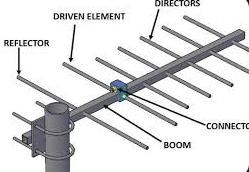
The antenna elements (reflector, driven element, and directors) were assembled according to manufacturer specifications. Proper spacing and alignment of these elements are crucial for achieving the rated gain and radiation pattern.

3. Mounting the Antenna

The Yagi was securely mounted to the tower/mast using appropriate brackets and hardware. Attention was given to:

  • Correct polarization (horizontal or vertical depending on system design)
  • Mechanical stability to withstand wind and weather
  • Safe routing for coaxial feedline

4. Feedline and Connections

High-quality coaxial cable was run from the antenna to the repeater system. All connections were:

  • Properly soldered or crimped
  • Weatherproofed to prevent moisture ingress
  • Strain-relieved to reduce mechanical stress

5. Aiming the Antenna

Because a Yagi is directional, precise aiming is key. The antenna was aligned toward the target coverage area using compass headings and signal testing to ensure maximum effectiveness.

6. Tuning and SWR Adjustment

Once installed, the antenna system was tested and tuned:

  • Standing Wave Ratio (SWR) was measured and adjusted for efficiency
  • Fine-tuning ensured minimal signal reflection and maximum power transfer
  • Any impedance mismatches were corrected

7. System Integration and Testing

Finally, the antenna was connected to the repeater system and brought online. Testing included:

  • On-air signal reports
  • Coverage checks across multiple locations
  • Audio quality verification

Ready for the Net

We’re proud to have completed this installation in time for tonight’s East Coast Reflector “Open Mic Night” net. This is a great opportunity for everyone to try out the upgraded system and experience the improved coverage firsthand.

We encourage all operators—near and far—to check in, give us a signal report, and enjoy the enhanced performance of the WB4RL Repeater.


Looking Ahead

This upgrade is part of our ongoing commitment to improving amateur radio infrastructure for our community. We appreciate everyone who contributed time, effort, and expertise to make this project a success.

See you on the air tonight!

— WB4RL Team

Getting Started with Ham Radio: Study Tips, Practice Tests, and Best Online Resources

Amateur (ham) radio is one of the most rewarding technical hobbies you can dive into—combining electronics, communication, and community. But before you can get on the air, you’ll need to pass a license exam. The good news? With the right study approach and tools, most people can pass their first test faster than they expect.


📡 Understanding the Ham Radio License Exams

In the United States, there are three license levels:

  • Technician (entry-level)
  • General
  • Amateur Extra

Each level requires passing a multiple-choice exam covering topics like radio theory, FCC rules, and operating practices. The Technician exam, for example, has 35 questions and is the most common starting point.

You don’t need to learn Morse code anymore—it’s no longer required.


🧠 Study Strategies That Actually Work

There are two main approaches to preparing:

1. Memorization (Fast Track)

  • Study the official question pool
  • Take repeated practice tests
  • Aim for 80%+ consistently before testing

2. Concept Learning (Long-Term Understanding)

  • Learn how radios and signals actually work
  • Watch video courses and read guides
  • Better for advancing beyond Technician

Most beginners use a mix of both, starting with memorization and building understanding over time.


🌐 Best Ham Radio Study Websites

Here are some of the most trusted and widely used study platforms:

🔹 Practice Test & Flashcard Sites

  • HamStudy.org – Flashcards + adaptive quizzes + real exam questions
  • HamExam.org – Simple, free practice exams
  • AA9PW Practice Tests – Clean interface with randomized tests
  • eHam.net – Practice exams and community resources

These sites use the actual FCC question pools, making them extremely effective.


🔹 Structured Courses & Study Guides

  • ARRL License Manuals – The “official” study books
  • KB6NU No-Nonsense Guides – Straightforward and beginner-friendly
  • HamTestOnline – Paid but structured learning system

ARRL also provides a Tech Prep Resource Library with study materials and courses.


🔹 Video-Based Learning (Highly Recommended)

  • Ham Radio Crash Course (YouTube) – Beginner-friendly explanations
  • Dave Casler (KE0OG) – Full license course walkthroughs
  • W4EEY classes – Full recorded classroom sessions

These are great if you prefer learning by watching instead of reading.


🔹 Mobile Apps for Practice

  • “Ham Radio Practice Test” apps (Android/iOS)
  • Offer hundreds of practice questions, mock exams, and progress tracking

Perfect for studying during downtime.


🧪 Practice Testing Tips

  • Take full-length timed practice exams
  • Review explanations for wrong answers
  • Focus on weak areas (rules, circuits, antennas, etc.)
  • Don’t just memorize—try to understand patterns

A good rule:
👉 If you consistently score 80–85% on practice tests, you’re ready.


📍 Finding a Real Exam Session

Ham radio exams are administered by Volunteer Examiners (VEs) under FCC guidelines.

You can:

  • Search for sessions on HamStudy.org
  • Check the ARRL website
  • Contact a local ham radio club

Typical requirements:

  • Photo ID
  • FCC Registration Number (FRN)
  • Small fee (FCC currently charges about $35)


🚀 Final Thoughts

Getting your ham radio license isn’t as hard as it might seem. With modern tools like online practice exams, video courses, and mobile apps, you can realistically go from beginner to licensed operator in just a few weeks.

Best starting plan:

  1. Use HamStudy.org daily
  2. Supplement with YouTube lessons
  3. Take practice tests until you’re consistently passing
  4. Schedule your exam

Once you pass, the real fun begins—experimenting, building, and making contacts around the world.

WB4RL Repeater 1 Year Later

WB4RL Repeater Celebrates One Year On the Air! 🎉

This month marks an exciting milestone for the WB4RL repeater—one full year of service on the air! What started as a vision has grown into a reliable and active hub for communication, connection, and community across our area.

Over the past year, the repeater has supported countless QSOs, provided a dependable resource during events, and helped bring both new and experienced operators together. From casual daily check-ins to more organized nets, WB4RL has become more than just a signal—it’s become a community gathering point.

Being part of the East Coast Reflector family has been a rewarding and exciting addition. Allowing you to access the world with national and international QSO’s the ECR has provided all of us contacts found no where else and weekly nets to enjoy.

This success would not have been possible without the incredible support from all of you. Whether you contributed time, technical expertise, equipment, or simply showed up and used the repeater, thank you. Every contact made and every voice heard has helped make WB4RL what it is today.

We also want to extend a special thanks to those who worked behind the scenes—handling setup, maintenance, troubleshooting, and improvements throughout the year. Your dedication has kept everything running smoothly and ensured that WB4RL remains a dependable resource for everyone.

And we’re not stopping here.

In the coming days, we’re excited to continue improving coverage with the addition of a new 7-element Yagi antenna with 11 dB gain, similar to the upgrade work completed just days ago at the WSHE379 GMRS Repeater. This enhancement will significantly extend the repeater’s reach into the Hartselle area, giving our friends there stronger, more reliable access to the system.

This is just the beginning. With your continued support, WB4RL will keep growing, improving, and serving the community for years to come.

Here’s to an amazing first year—and many more ahead!

73,
The WB4RL Team

WSHE379 Yagi Antenna Upgrade Completed

We’re excited to announce that the WSHE379 system has been upgraded with a high-performance Yagi antenna—bringing stronger, clearer, and more reliable communications to our community!

🔧 What’s new?
The addition of a directional Yagi antenna significantly boosts signal gain by focusing radio energy in a specific direction rather than spreading it evenly. This means:

  • 📡 Increased range in the targeted coverage area
  • 🔊 Stronger, clearer signals with less noise and interference
  • 🎯 Improved reliability, especially in challenging terrain or longer distances

Why this matters for GMRS users
Operating on GMRS (General Mobile Radio Service) frequencies, WSHE379 plays an important role in keeping our community connected. With this upgrade:

  • Families and neighbors can communicate more effectively
  • Emergency coordination becomes more dependable
  • Outdoor groups and local events benefit from better coverage

This enhancement ensures that when you key up your radio, your signal goes farther and comes through clearer than ever before.

🙌 Thank you to everyone who supported and helped make this upgrade possible. Stay tuned, stay connected, and as always—radio on!

#WSHE379 #GMRS #RadioUpgrade #CommunityComms

WSHE379 Repeater News Update – New Antenna Installation (March 21, 2026)

We’re excited to share a major upgrade to the WSHE379 GMRS repeater system happening this weekend! On March 21, 2026, we will be installing a new 7-element Yagi antenna to enhance our coverage and overall performance.

This upgrade brings a significant improvement in signal strength, with the new antenna providing approximately 11 dB of gain. In practical terms, that means a much stronger and more focused signal compared to our current setup. An 11 dB gain increase can effectively multiply our radiated power in the desired direction, allowing signals to travel farther while maintaining clarity and reliability.

One of the key advantages of a Yagi antenna is its directional capability. Unlike omnidirectional antennas that spread signal equally in all directions, the 7-element Yagi concentrates energy in a specific direction. For our installation, this beam will be oriented westward, allowing us to strategically expand coverage where it’s needed most.
This means improved reception and transmit performance along the I-65 corridor and into the Hartselle area, with:

  • Stronger signal penetration into buildings and mobile environments
  • Reduced signal dropouts while traveling along I-65
  • More consistent coverage in previously weak or fringe areas
  • Improved overall audio quality for stations in the west coverage zone
  • Additionally, the directional nature of the antenna helps reduce interference from other directions, making the repeater more efficient and reliable for all users.

We’re looking forward to hearing your signal reports after the installation. As always, your feedback will help us fine-tune and optimize performance.

Thank you for your continued support of the WSHE379 repeater system!

73,
WSHE379 Team

CB Radio as an Emergency Backup: Why Multiple Radio Types Matter

When severe weather strikes or an unexpected emergency unfolds, communication becomes the most important tool you have. For the WSHE379 GMRS community, staying connected can mean the difference between confusion and coordination, isolation and assistance. While GMRS is an excellent primary system for family and community communication, having more than one type of radio available is a critical part of emergency preparedness. One of the most valuable backup options is Citizens Band (CB) radio.

Why Redundant Communication Matters

Emergencies rarely unfold in predictable ways. Power outages, damaged infrastructure, overloaded cellular networks, and even terrain can all disrupt communication. That’s why experienced emergency communicators rely on redundancy—having multiple systems that can operate independently of each other.

If one system fails, another can take its place.

In a severe weather event, for example:

  • Cell networks may become congested or fail.
  • Internet-based communications can go offline.
  • Repeaters used by GMRS or amateur radio systems may lose power.

Having a backup radio service that operates independently ensures you still have a way to communicate.

What Is CB Radio?

CB (Citizens Band) radio is a short-range radio service that operates on 40 channels in the 27 MHz band. Unlike GMRS, CB does not require a license in the United States and is widely used by truck drivers, travelers, off-road groups, and rural communities.

CB radios have been a staple of emergency communication for decades because they are:

  • Simple to use
  • Widely available
  • Independent of infrastructure
  • Operable during power outages with battery power

Even when other systems are unavailable, CB radios can often still reach nearby drivers, travelers, and residents who may be monitoring channels.

Why CB Makes a Good Backup to GMRS

While GMRS provides clearer audio, repeaters, and more structured community communication, CB offers a different frequency band and user base. That difference can become an advantage during emergencies.

Here are several reasons CB works well as a backup system:

1. Different Frequency Band
CB operates on 27 MHz (HF), while GMRS operates around 462–467 MHz (UHF). If conditions affect one band, the other may still function well.

2. Different User Community
Truck drivers frequently monitor CB Channel 19. During major highway incidents, weather events, or evacuations, this can provide valuable real-time information from people already on the road.

3. Infrastructure Independence
CB requires no repeaters or internet connections. Communication is radio-to-radio, which makes it resilient when systems fail.

4. Wide Availability
CB radios are inexpensive and widely sold. Many vehicles, especially in rural areas, already have them installed.

Weather Events and Emergency Use

In severe weather situations such as:

  • Tornado outbreaks
  • Ice storms
  • Flooding
  • Hurricanes
  • Long-term power outages

communications infrastructure can fail quickly. A prepared household may have:

  • A GMRS radio for family and neighborhood coordination
  • A CB radio to hear highway and regional traffic reports
  • A NOAA weather radio for official alerts

Each radio serves a different purpose, creating a layered communication strategy.

Staying Connected When It Matters Most

Preparedness is not just about having equipment—it’s about having options. The more communication paths available to you, the more likely you are to stay informed and connected during a crisis.

The WSHE379 GMRS network is built around community support and reliable communication. Adding a CB radio as an emergency backup strengthens that mission by ensuring members have additional ways to share information and reach others when conditions are at their worst.

A Simple Preparedness Step

If you already operate GMRS radios, consider adding a small CB radio to your emergency kit or vehicle. It’s a simple and affordable way to increase your resilience during severe weather and unexpected events.

When emergencies happen, redundancy saves lives.
Stay prepared, stay informed, and most importantly—stay connected.

Thanks to Laura at Retevis — you can now equip your family with reliable, affordable radio communications just in time for storm season. Use Coupon code ZRTSAVES for $5 off your purchase

MeshCore vs Meshtastic: Off-Grid Digital Communication for Amateur Radio

Over the past few years, a new type of communication network has been gaining popularity in the amateur radio and maker communities: LoRa mesh networking. Two of the most talked-about systems are Meshtastic and MeshCore.

Both allow users to send messages across long distances using low-power radios without relying on cellular networks or internet infrastructure. For emergency communications, experimentation, and off-grid messaging, these systems are becoming an exciting addition to the modern radio toolkit.

Let’s look at what they are, how they work, and how you can get started.

What is LoRa Mesh Networking?

Both systems use LoRa (Long Range radio) technology operating in the license-free ISM bands (typically 915 MHz in the United States). LoRa allows radios to transmit very small amounts of data over long distances with extremely low power consumption.

Instead of communicating directly point-to-point, devices form a mesh network. Each radio node can relay messages to others, allowing communication far beyond the range of a single transmitter.

This makes it possible to:

  • Send text messages across towns or cities
  • Build off-grid communication systems
  • Deploy emergency backup communications
  • Track GPS locations
  • Create sensor networks

Messages hop from node to node until they reach their destination.

What is Meshtastic?

Meshtastic is one of the most popular open-source LoRa mesh networking platforms today.

It uses inexpensive LoRa radios paired with a smartphone app to send and receive encrypted messages across the mesh network.

Key Features

  • Off-grid text messaging
  • AES-256 encrypted channels
  • GPS location sharing
  • Smartphone apps (Android & iOS)
  • Easy setup and large community

Meshtastic uses a technique called managed flooding, where nodes rebroadcast messages so they propagate across the network. Messages typically travel up to 7 hops through other radios.

Best Use Cases

Meshtastic excels in situations where users are mobile or temporary, such as:

  • Hiking and outdoor activities
  • Public events
  • Emergency response groups
  • Amateur radio experiments
  • Disaster preparedness

Because every node can relay traffic, a network can form automatically as users join.

What is MeshCore?

MeshCore is another open-source LoRa mesh system but designed with a different philosophy.

Rather than having every device relay messages, MeshCore uses dedicated repeater nodes to handle network routing. Personal devices are called companion nodes, which connect to repeaters but do not relay traffic themselves.

Key Features

  • Structured routing architecture
  • Multi-hop routing (up to ~64 hops)
  • Store-and-forward messaging
  • Optional end-to-end encryption
  • Modular firmware roles (repeaters, companions, servers)

Because routing is more structured, MeshCore networks can be more efficient and less congested when properly designed.

Best Use Cases

MeshCore works best when you can deploy fixed infrastructure nodes, such as:

  • Rooftop repeaters
  • Solar powered hilltop nodes
  • Community mesh networks
  • City-wide emergency systems

MeshCore vs Meshtastic: Key Differences

FeatureMeshtasticMeshCore
Network TypeAd-hoc meshInfrastructure-based mesh
RoutingManaged floodingPath-based routing
Hop Limit~7 hopsUp to ~64 hops
Node RolesAll nodes can relayRepeaters relay traffic
Ease of SetupVery easyMore planning required
Community SizeVery largeSmaller but growing

In simple terms:

  • Meshtastic = quick, easy, spontaneous networking
  • MeshCore = structured networks with dedicated infrastructure

Many groups experiment with both systems, sometimes using the same hardware with different firmware.

Hardware You Can Use

Most mesh nodes are small development boards that combine:

  • A microcontroller
  • A LoRa radio chip
  • Optional GPS
  • Bluetooth or Wi-Fi

Popular hardware includes:

  • LILYGO T-Beam
  • Heltec LoRa32 V3
  • RAK4631 WisBlock
  • LILYGO T-Deck

These devices typically cost $20–$80, making them affordable for experimentation.

Most run for days on small batteries thanks to LoRa’s low power consumption.

Many of these boards support both Meshtastic and MeshCore, so you can simply re-flash firmware to switch between systems.

How to Get Started

1. Buy a LoRa Node

Choose a supported board like a T-Beam or WisBlock.

2. Install Firmware

Flash either Meshtastic or MeshCore firmware onto the device.

3. Install the Mobile App

Meshtastic has official Android and iOS apps.
MeshCore typically uses companion apps or command-line tools.

4. Connect via Bluetooth or USB

Your phone connects to the radio which becomes your gateway to the mesh.

5. Start Messaging

Once two or more nodes are online, the mesh begins forming automatically.

Range Expectations

Range depends heavily on terrain and antenna height.

Typical results:

  • Urban areas: 1–5 miles
  • Suburban areas: 5–15 miles
  • Hilltop to hilltop: 30–100+ miles

With multiple nodes relaying messages, networks can span entire regions.

Why Amateur Radio Operators Are Interested

While these systems operate on unlicensed ISM bands, they share many principles with amateur radio networking:

  • Digital experimentation
  • Mesh networking
  • Emergency communications
  • Infrastructure building
  • Community collaboration

Many amateur radio groups are experimenting with mesh nodes alongside traditional radio systems to create hybrid emergency communication networks.

Final Thoughts

Both MeshCore and Meshtastic represent a new generation of digital radio experimentation. With inexpensive hardware and open-source software, anyone can participate in building decentralized communication networks.

If you’re interested in experimentation, emergency communications, or just learning something new, LoRa mesh networking is worth exploring.

And as always in amateur radio…

The best way to learn is to get on the air and experiment.
